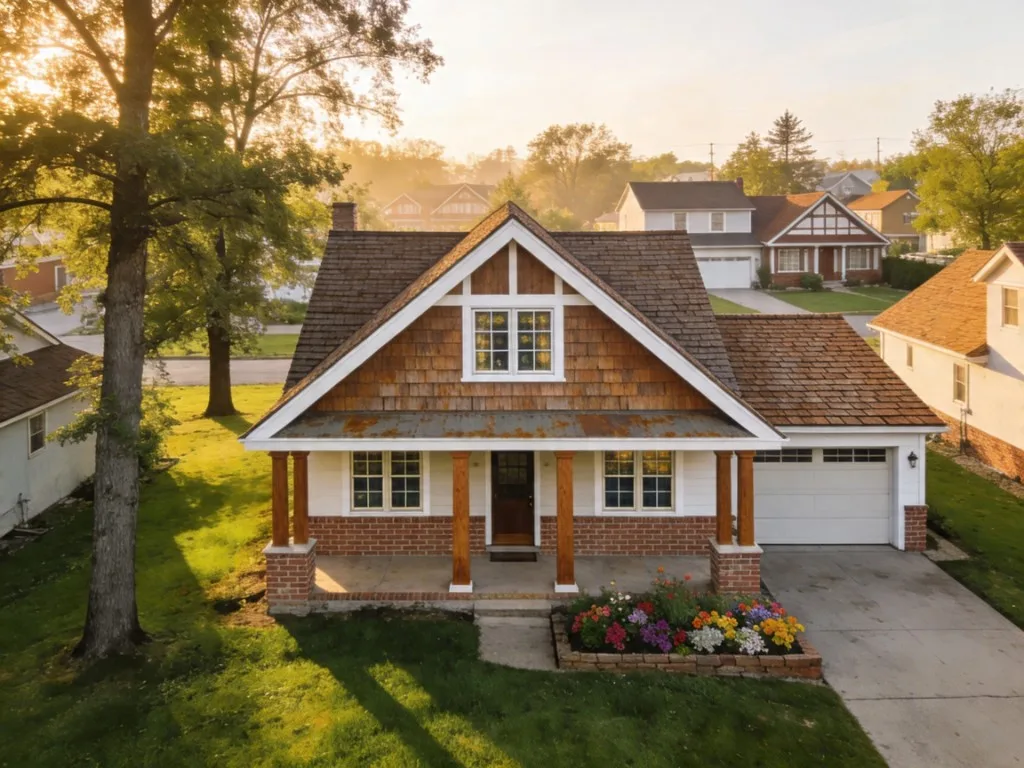
Durham sellers call us for very different reasons: an estate house in Old North Durham that no one wants to clean out, a rental near Duke that the owner now manages from another state, a Bahama property that needs a new roof and a septic check, or a notice of foreclosure with a sale date on the calendar. We are a veteran-owned buyer with our own acquisitions team, so the person who reads your file is the person who prices it, and the same offer formula applies whether the house needs paint or a structural fix.
How Does Selling Your Durham House to Home Pros Work?
Three steps, from your first message to cash in hand.
1. Tell Us About Your House
- Share the address, condition, and your timeline
- No walkthrough needed to start
- It takes about two minutes
2. Get Your Cash Offer
- A written, no-obligation offer within 24 hours
- Built on recent comparable sales and repair costs
- No appraisal or lender to wait on
3. Pick Your Closing Date
- Close in as little as 7 days
- Or choose a date, typically 14 to 30 days out
- We cover the closing attorney's fee
How Do We Calculate a Cash Offer on a Durham House?
The same formula every time, shown to you before you sign.
We estimate what your house would sell for after repairs (the after-repair value), subtract the cost of the work it needs, then subtract a margin for our holding costs, closing costs, and the risk of reselling. What is left is your offer. You can run your own numbers in the cash offer calculator or read the full offer breakdown.
Illustration: a Durham house needing moderate repairs
The median property value in Durham was $392,800 in 2024 (Data USA, American Community Survey 2024). Take a house at that value that needs a roof, HVAC, and flooring: after-repair value about $393,000, minus $50,000 in estimated repairs, minus $49,000 for margin, holding, and closing costs, gives a cash offer near $294,000. A cosmetic-only house at the same value (paint, fixtures, landscaping) might run $393,000 minus $12,000 in repairs minus $40,000 in margin and costs, or about $341,000. These are illustrations of the method, not quotes. Your offer depends on your street, your condition, and recent sales nearby.
What Is the Difference Between a Cash Sale and Listing in Durham?
What each path costs, and how long it takes.
A listing can net more on a house in good condition when you have months to spare. A cash sale wins when time, condition, or certainty matter more than the last few percent. Run both sets of numbers in our cash offer vs. listing calculator.
What Is Different About Selling a House in Durham?
Where we buy in Durham County
Durham is not one market, and we price each house from comparable sales on its own street rather than a citywide average. Close to downtown, Old North Durham, Trinity Park, Watts-Hillandale, Duke Park, and Walltown are older neighborhoods where houses often arrive with decades of deferred maintenance or an estate to settle. East Durham and Lakewood, south Durham around Southpoint, Woodcroft, and Hope Valley, and the Brier Creek, Bahama, and Rougemont areas to the north all see different repair scopes and buyer demand, so the offer for a roof and HVAC job in one is not the offer in another. Across the county line we also buy in Chapel Hill, Carrboro, and Hillsborough in Orange County, and in Morrisville. If a house has a well, a septic system, an oil tank, or an unpermitted addition, tell us; we price those in rather than asking you to fix them first.
The deed excise tax and the Durham County Register of Deeds
Every deed recorded in North Carolina carries an excise tax of $1 for each $500 of the price, or fraction of $500, paid by the seller to the register of deeds before recording (N.C. Gen. Stat. 105-228.30). At Durham's 2024 median property value of $392,800, that is $786. The recording itself carries a uniform statewide fee of $26 for the first 15 pages and $4 for each additional page (G.S. 161-10). The Durham County Register of Deeds is at 201 East Main Street, 2nd Floor, in the Durham County Administration Building II. In a listed sale these are normal seller closing costs. When you sell to us, we pay them.
Foreclosure in Durham County: power of sale and the 10 day upset bid
North Carolina lenders foreclose by power of sale. They file a notice of hearing with the clerk, and the clerk, not a trial judge, decides whether the debt, default, and right to foreclose are established (G.S. 45-21.16). In Durham County that clerk is the Durham County Clerk of Superior Court, at 510 S. Dillard Street, which lists foreclosures under power of sale among its special proceedings. Notice of the sale has to be posted at least 20 days before it and published for two successive weeks in a qualifying newspaper (G.S. 45-21.17). After the sale, anyone can submit an upset bid of at least 5% more (minimum $750 more), and every bid restarts a 10 day clock (G.S. 45-21.27). The practical point for an owner: you often have more time than the first letter suggests, and a cash closing before the sale date can pay off the loan, stop the process, and leave you whatever equity remains. We cover the timeline in our upset bid explainer and our guide to selling before foreclosure.
Inherited a Durham house? The small-estate affidavit will not transfer it
If a relative died without a will, North Carolina lets an heir collect personal property worth $20,000 or less by affidavit after 30 days, or up to $30,000 when a surviving spouse is the sole heir (G.S. 28A-25-1). That process reaches bank accounts and similar personal property. It does not convey real estate. A Durham house generally still goes through the estate, supervised by the Clerk of Superior Court in the county of the decedent's residence. We can put a written offer in front of the family while that process runs, and an estate sale by a personal representative is also exempt from the state disclosure form. Our North Carolina inherited house guide walks through the steps.
Selling as-is still involves a disclosure form, with exceptions
North Carolina's Residential Property Disclosure Act (N.C. Gen. Stat. Chapter 47E) applies to most private sales even when the house is sold as-is. The seller either completes the disclosure statement or checks the box declining to make representations, which puts that risk on the buyer. The Act exempts transfers pursuant to a court order in an estate, foreclosure sales, and transfers by a fiduciary administering an estate, trust, guardianship, or conservatorship, among others. If you are unsure which applies, the closing attorney will tell you before you sign.
Durham County taxes: the 2025 values and what to watch before January
Durham County's current tax values are effective January 1, 2025. The county reports that total taxable value grew from $43 billion in 2019 to more than $70 billion in the 2025 reappraisal, and that the FY 2026-27 tax rate is 0.5742 (Durham County Tax Administration's reappraisal FAQ). On a $392,800 house, the county rate alone works out to roughly $2,255 a year, before any city tax. Two dates matter this quarter. North Carolina property taxes are due September 1, are payable at face value before January 6, and then start accruing 2% interest, followed by 0.75% a month (G.S. 105-360). And although the 2026 appeal deadline of June 17 has passed, the Board of Equalization and Review can accept a late application until December 31, so owners who think their value is too high still have a narrow window. If you are carrying a tax bill on a house you cannot keep, a cash sale lets us pay it from your proceeds at closing.
A closing attorney handles every Durham closing
North Carolina allows only licensed attorneys to handle most of a residential closing: the title opinion, the deed, recording, and disbursing funds (Authorized Practice Advisory Opinion 2002-1). That applies to cash and financed sales alike. What changes with Home Pros is that we pay that attorney, there is no lender underwriting to wait on, and you can often sign by mail or remote notary if you live out of state. On closing day the attorney pays off any mortgage, lien, or tax balance from the proceeds, records the deed with the register of deeds, and sends you the rest.
What Durham Situations Do We Buy In?
Whatever is going on, we can usually find a way to make it work.
Inherited a house
Skip cleanout, repairs, and showings on a property no one planned to keep. Read the inherited house guide.
Facing foreclosure
We can often close before a sale date, paying off the loan and protecting what equity remains. See how.
Behind on property taxes
We pay Durham County back taxes, interest, and penalties out of closing so you do not write a check first.
Tenants in place
We buy occupied rentals as-is, with no eviction or lease buyout required first. Selling with tenants.
Divorce
A quick, neutral cash sale can simplify splitting proceeds on a house neither person wants to manage. Divorce sale guide.
Code violations and deferred repairs
Open permits, old systems, and violations are priced into the offer. You do not fix them first.
Out-of-state owners
Stop paying insurance, taxes, and upkeep on an empty Durham house, and close remotely.
Relocating
Pick a closing date that fits your move instead of a listing schedule.
Durham Seller FAQ
Do you really buy houses in any condition in Durham?
Yes. We buy Durham houses as-is, including homes with roof or foundation problems, fire or water damage, code violations, unpermitted additions, deferred maintenance, or years of belongings still inside. You do not repair, clean, or stage anything. We account for the condition in the offer and show you the math before you sign.
How fast can I sell my Durham house for cash?
We make a no-obligation offer within 24 hours of getting your address and details. If you accept, we can close in as little as 7 days, or on a later date you pick. Most closings land between 14 and 30 days. The closing attorney's title search is usually the step that sets the pace.
Do I need a lawyer to close in Durham?
Yes. North Carolina reserves residential closings for licensed attorneys under the State Bar's Authorized Practice Advisory Opinion 2002-1. That attorney runs the title search, prepares the deed, and disburses funds. When you sell to Home Pros, we pay the closing attorney's fee. You can use our attorney or tell us about one you prefer.
How much is the excise tax when I sell a house in Durham County?
North Carolina charges $1 for every $500 of the sale price, or fraction of $500, on the deed, paid by the seller to the Register of Deeds (G.S. 105-228.30). At Durham's 2024 median property value of $392,800 that is $786. When you sell to Home Pros, that cost is on our side of the ledger, not yours.
I inherited a house in Durham with no will. Can I sell it without probate?
Usually not the house itself. North Carolina's small-estate affidavit (G.S. 28A-25-1) covers personal property up to $20,000, or $30,000 when a surviving spouse is the sole heir, and it does not transfer real estate. Durham estates run through the Clerk of Superior Court. We can make a written offer while the family sorts out who has authority to sign.
What happens if my Durham house is already in foreclosure?
North Carolina is a power-of-sale state, so a lender needs a hearing before the clerk (G.S. 45-21.16) rather than a lawsuit. Notice of sale must be posted at least 20 days before the sale (G.S. 45-21.17), and each sale is followed by a 10 day upset bid window (G.S. 45-21.27). A cash closing before the sale date can stop the process and protect your equity.
Did my Durham County property tax value change, and what if I owe back taxes?
Durham County's current values are effective January 1, 2025. Taxes are due September 1 and are not charged interest if paid before January 6; after that, interest starts at 2% and then runs 0.75% a month (G.S. 105-360). If you owe back taxes, we pay them from your proceeds at closing so you do not have to come up with cash first.
Do I still have to give a disclosure form if I sell as-is?
In most private sales, yes. Chapter 47E requires the Residential Property Disclosure Statement, but a seller may check the box declining to make representations. Transfers by a fiduciary administering an estate, and foreclosure sales, are exempt. If you sell to Home Pros, we are buying with full knowledge that the home is as-is.
Which parts of Durham County do you buy in?
We buy across the city of Durham and Durham County, including Downtown, Old North Durham, Trinity Park, Watts-Hillandale, Duke Park, Walltown, East Durham, Lakewood, Southpoint, Woodcroft, Brier Creek, Bahama, and Rougemont. We also buy in Chapel Hill, Carrboro, and Hillsborough in Orange County, and in Morrisville and the rest of the Triangle.
Is there really no cost to me?
Correct. There is no commission because no agent is involved, we pay standard closing costs and the closing attorney's fee, and there are no service fees. The figure in your purchase agreement is what you receive at closing, less any mortgage or lien payoffs you still owe on the property.
Is Home Pros a real company or a lead-generation site?
Home Pros is the trade name of Balint Holdings, LLC, a veteran-owned cash home buyer with a 4.9 star Google rating from 98 reviews and BBB accreditation. Our own acquisitions team works your file, and we do not resell your information to an outside investor. You can verify both profiles before you sign anything.
We Also Buy Houses Across North Carolina
Wherever your property is, we are ready to make an offer.
Around Durham
- Chapel Hill and Carrboro
- Hillsborough
- Morrisville
- Research Triangle Park
Elsewhere in North Carolina
Written by
Trevor Rice
Co-founder and COO of Home Pros, and a licensed Texas real estate agent. Trevor oversees Home Pros' acquisitions across its service states, including North Carolina.
Updated October 10, 2026
Get a Fast Cash Offer in Durham
Share a few details and we'll deliver a fair, no-obligation offer within 24 hours.
Have questions? Call (830) 510-1597.